cēsu stāsti
LV / EN
Home / Cesis House /Polyclinic
Cesis House

Polyclinic

Time · 1776.-1951. g.

Interesting facts

Unusual stories are hidden in the walls of this building - it has served not only as a government institution and a place of healing, but also as a printing house, kindergarten, and even a room for Adventist church services.

The parade doors, which were bricked up in 1949, still preserve the stamp of the Cēsis brick factory - bricks from this same kiln were also used for the restoration of the Moscow Kremlin wall.

Facts

18th century: The territory was known as "the garden before Catherine's Gate" or "Schultz's Garden."

1776: The garden was acquired by Lieutenant Colonel Heinrich Burhard von Sievers from Glūda.

1795: The garden was sold to Court Counselor Franz Johann von Zoeckel and Magistrate Samuel Ludwig von Kieter for 125 Albert state thalers.

1878: The real estate was purchased by ornithologist Oskar von Löwis of Menar for 10,000 rubles.

1880: A two-story brick building was constructed according to the design of contractor Johan Hoppe.

1889: A lease agreement was concluded with the Cēsis-Valka Magistrate's mortgage department for 1,300 rubles per year.

1899: After Oskar von Löwis of Menar's death, the property was inherited by his widow Alexandra

1902: The property was sold to nobleman Gaston von Pistolkors for 16,500 rubles

1911: The property was acquired by Baron Erich Voldemar von Maydell for 22,500 rubles

1913: The property was purchased by Emma Špora for 25,000 rubles

1919: The Cēsis printing house was located in the building, where "Cēsu Vēstnesis" was printed.

1930: Elvīra Grosa's private kindergarten and preschool operated in the house.

1937: Property owner Emma Špora died, and the property was inherited by her children Erika Krēmere and Arvīds Špors

1939: Erika Krēmere repatriated to Germany, her share of the property was taken over by the Latvian Credit Bank

1949: The building's reconstruction into an outpatient clinic began, with the front doors bricked up

1951: The building was officially put into operation as a polyclinic

Present day: The building is uninhabited

The story

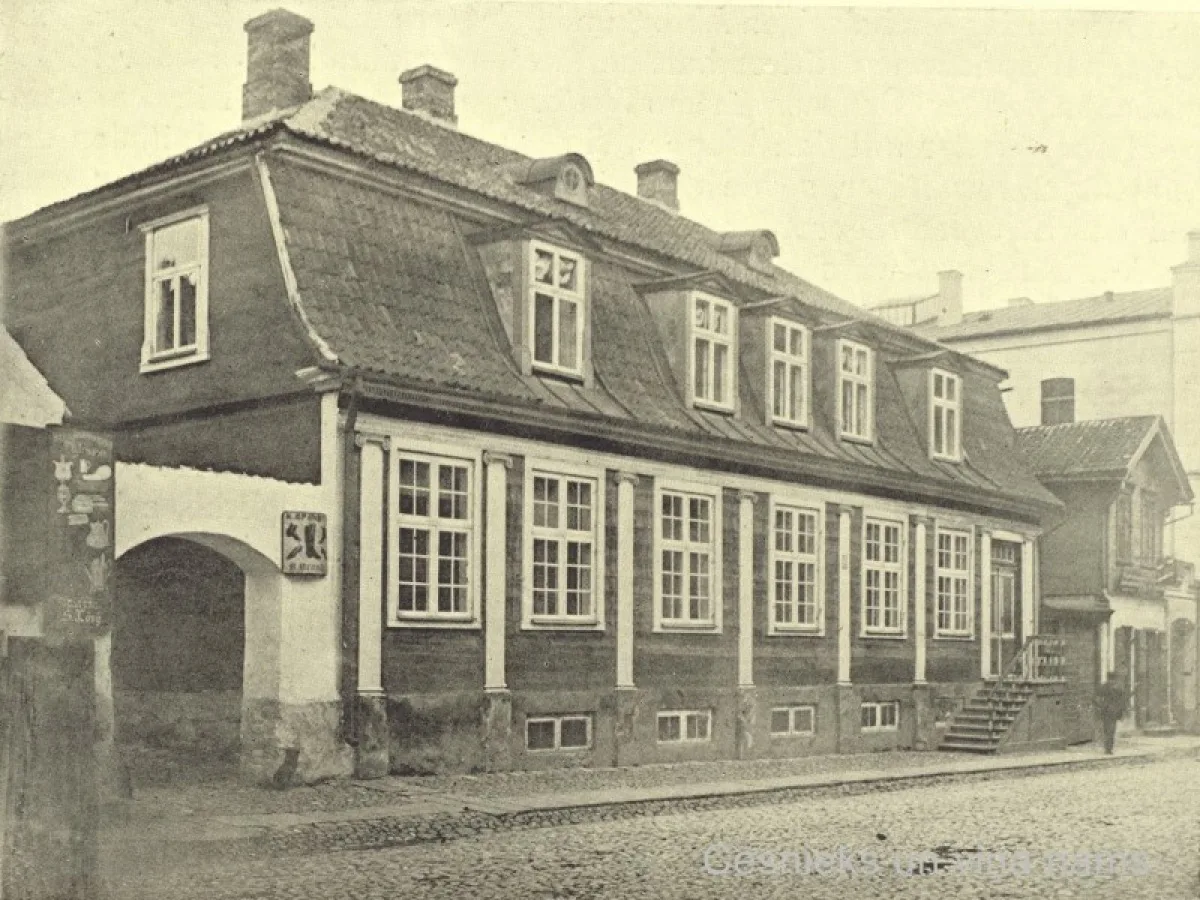
The building known to many generations of Cēsis residents as the polyclinic has written its name in the city's history with a rich story of changing owners and functions. It's hard to imagine that in the 18th century, this site was merely a garden, described in documents as "the garden before Catherine's Gate" – an area located outside the city's defensive wall.

The current two-story brick building was constructed in 1880 according to the design of contractor Johan Hoppe, when the land belonged to the notable natural scientist and ornithologist Oskar von Löwis of Menar. Before the building's construction, this plot of land, known as "Schultz's Garden," traveled from one owner to another for a century until it came into von Löwis of Menar's possession, who purchased it in 1878 for an impressive 10,000 rubles.

After the building's construction, Oskar von Löwis rented his property to state institutions – the Cēsis-Valka Magistrate's mortgage (land registry) department and the 1st district judge's chamber. The lease agreement, concluded in 1889, provided for the premises to be used for 1,300 rubles per year. The owner committed to carrying out necessary repairs and even covering street maintenance, waste disposal, and chimney cleaning expenses – truly a lordly gesture!

After Oskar von Löwis's death in 1899, the property was inherited by his widow Alexandra, who later moved to Dresden and sold the house to nobleman Gaston von Pistolkors for 16,500 rubles in 1902. The property changed several owners until Emma Špora acquired it in 1913, whose family managed it until the beginning of World War II.

The building's premises were used for various purposes over the years – it housed the Cēsis printing house, Elvīra Grosa's private kindergarten, a sewing workshop, and even Adventist church services. After Emma Špora's death in 1937, the property was inherited by her children Erika Krēmere and Arvīds Špors. Unfortunately, in 1939, Erika repatriated to Germany, leaving her share of the property, which was taken over by the Latvian Credit Bank.

After World War II, during the Soviet era, the house was reconstructed as an outpatient clinic in 1949, with the front doors bricked up using bricks produced at the Cēsis building materials factory. Since then, the building has served as a medical institution, and although various doctors practice there today, Cēsis residents still affectionately call it the "polyclinic."

This building, whose history began as a simple garden outside the city walls, has become part of the city's identity – from a noble property to an important public healthcare institution. It is a living testimony to the transformation of Cēsis through time, political regimes, and societal changes.

The materials used for the description are:

Dace Cepurīte, Mg. hist., Research “Cēsnieks un jego nams”

Collections of the Cesis Castle Museum and the Central Library
Timeline of events

1776
Dārzu ieguva pulkvežleitnants Heinrihs Burhards fon Zīverss no Glūdas.
1795
Dārzs tika pārdots galma padomniekam Francim Johanam fon Cekelam un rātskungam Zamuelam Ludvigam fon Kīteram par 125 Alberta valstsdālderiem.
1878
Nekustamo īpašumu iegādājās ornitologs Oskars fon Lēviss of Menārs par 10 000 rubļiem.
1880
Uzcelta divstāvu ķieģeļu ēka pēc būvuzņēmēja Johana Hoppes projekta.
1889
Ēka izīrēta Cēsu-Valkas miertiesas hipotēku nodaļai par 1300 rubļiem gadā.
1899
Pēc Oskara fon Lēvisa of Menāra nāves īpašumu mantoja viņa atraitne Aleksandra.
1902
Īpašums pārdots muižniekam Gastonam fon Pistolkorsam par 16 500 rubļiem.
1911
Īpašumu iegādājās barons Erihs Voldemara d. Maidels par 22 500 rubļiem.
1913
Īpašumu nopirka Emma Špora par 25 000 rubļiem.
1919
Ēkā izvietojās Cēsu tipogrāfija, kur iespieda "Cēsu Vēstnesi".
1930
Namā darbojās Elvīras Grosas privātais bērnu dārzs un pirmsskola.
1937
Īpašumu manto Erika Krēmere un Arvīds Špors.
1939
Erika Krēmere repatriējās uz Vāciju, viņas īpašuma daļu pārņēma Latvijas Kredītbanka.
1949
Sākās ēkas pārbūve par ambulanci, aizmūrējot parādes durvis.
1951
Ēka oficiāli nodota ekspluatācijā kā poliklīnika.
18.gadsimts: Teritorija zināma kā "dārzs pirms Katrīnas vārtiem" jeb "Šulca dārzs".
Mūsdienas: Ēka nav apdzīvota
Location
Cēsis
Object on map