


The Cīrulīši neighborhood, located in the southwest of Cēsis, is a place with a rich and colorful history. It most likely got its name from the “Zeirul” estate (on 20th-century maps, “Cīrulis”) located in this area.
Information about the Cīrulīši houses is very scarce. 1688. In 1688, on the map of Cēsis residents’ land plots drawn by land surveyor Johann Heinrich Kelch, the Cīruļi houses appear as a single small building. Later, in 1750, the villages of Cīrulis and Mūrleja belonged to a burgomaster named Hans. The Mūrleja estate is later found in the 19th-century manor revisions of Meijermuiža, while the Cīruļi houses became a separate estate. From this, it can be assumed that the Cīrulīši estate was established at the end of the 18th century as a property of Meijermuiža.
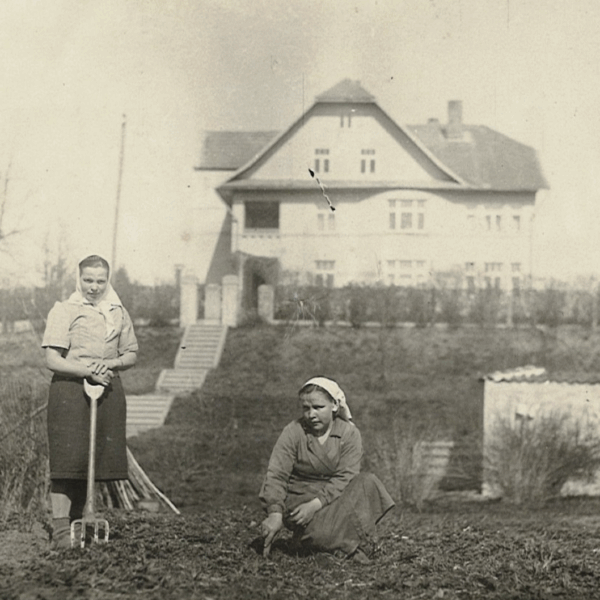
A particularly interesting turn in Cīrulīši’s history occurred in the 1930s when, after the emigration of the estate’s last owner, a children’s summer camp was established there. From this moment, Cīrulīši’s history as a resort began. 1932. In 1932, the Cēsis Resort Committee was founded with the aim of developing the city as a winter resort. In the same year, the largest ski jump in the Baltic States was built in Cīrulīši for ski jumping—many winter tourists participated in its opening competitions, thanks to a special train introduced from Riga for the occasion.
During World War II, Cīrulīši housed a hospital for German officers; in 1944, a pioneer camp was established, and already in 1945, the recreation center “Cīrulīši” with 56 beds was opened in the former manor. During the Soviet era, extensive construction took place here, developing the resort infrastructure. The All-Union Sanatorium “Cīrulīši” was built, which in its heyday—the 1980s—served 800–1000 people daily. The sanatorium employed about 300 staff and operated five residential buildings with 772 beds, which were overcrowded in summers. Various treatment and recreational services were offered: water and mud procedures, a gym, a swimming pool, a cultural club with 500 seats, a library and reading room, a dance hall, and extensive sports activities.
After the collapse of the USSR, the flow of visitors from the former Soviet republics rapidly decreased. The sanatorium suffered losses, its operations ceased in 1993, and in 1995, it was privatized and ceased to exist as a unified complex. 20. In the 1990s, the historic manor building was destroyed, with only the greenery and path network remaining.
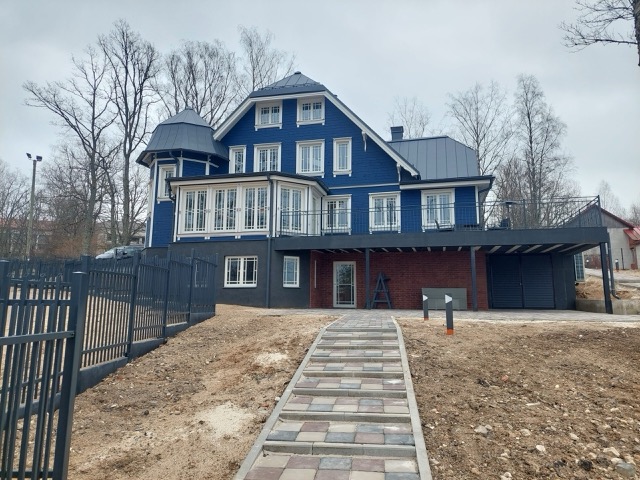
Today, the Cīrulīši neighborhood is undergoing revitalization. Since 2018, streets have been renovated, and abandoned buildings demolished. 2022. In 2022, a modern nature observation tower—the “Green Tower”—was opened on the top of Cīruļkalns hill. 2023. In 2023, the Cēsis Space Exploration Center was opened, and in 2025, the only preserved manor building, now known as the “Baroness’s House” and housing a guesthouse, was restored.
The materials used for the description are:
Ilma Zālīte, Mg. hist. and Cēsis Rotary Club project “Walk Around Cēsis Manors”