

In the autumn of 1917, when Latvia was caught up in a whirlwind of political change, Cēsis Realschule student Felikss Lindiņš, together with fellow young Bolsheviks — Pauls Vīksne, Pēteris Ustups, Alfrēds Menģelis, and Voldemārs Ozols — founded the youth workers’ circle “Kvēle” in Cēsis, which operated under Bolshevik party leadership. The organisation became an important platform for young people who wanted change, and through effective political agitation they were drawn into the revolutionary movement.
“Kvēle” was more than just a political organisation — it became a place where young people could both learn and socialise. The circle had social-scientific, drama, and games sections, offering a wide range of activities. Party members gave lectures on political and scientific topics, while the drama and games sections were full of fun and creativity, attracting many young people. Particularly popular were the question evenings, where lively debates took place with the participation of realschule and gymnasium students who were not yet “Kvēle” members — you could say these were Cēsis’s first brainstorming sessions, just with a revolutionary twist!
Some Latvian riflemen stationed in Cēsis also took an active part in the circle’s work, further strengthening its militantly revolutionary spirit. Working closely with the Bolshevik party, “Kvēle” actively took part in election campaigns and other public events.
The most prominent figures in “Kvēle” were its ideological leaders and mentors. Pauls Vīksne, a student at the Tartu Teachers’ Institute and later head of the Cēsis District Militia, used his outstanding speaking skills to passionately explain political events to young people and became a well-respected mentor. But the true soul of “Kvēle” was and always remained Felikss Lindiņš — an outgoing, straightforward, principled, energetic, and warm-hearted young man who skilfully organised and led the circle’s work. If you needed to find Felikss, there was no need to ask around — everyone knew he would be at “Kvēle”.
In February 1918, during the German occupation of Cēsis, the circle’s activities were briefly interrupted — some members were arrested, others placed under police supervision, and rural students returned to their families. But already in March, Felikss Lindiņš re-established contact with Emma Plūme (known as Vētra), a representative of the Bolshevik party’s underground organisation Vidiena. Together with Vētra, a meeting of Cēsis district Bolsheviks was held in the forest behind the barracks, where it was decided to continue “Kvēle’s” revolutionary work underground.
After Soviet representatives returned to Cēsis, “Kvēle” resumed its activities in December 1918, attracting new members from both student and Soviet employee circles. In March 1919, “Kvēle” sent its representatives — Kārlis Martinsons-Miks, Felikss Lindiņš, and Aļis Blanks — to the 1st Congress of Latvian Youth Workers in Riga, where Kārlis and Felikss were elected to the Central Committee.
In May 1919, Felikss Lindiņš, having failed to evacuate from Riga with the Soviet army, was arrested. He was later released due to poor health, but stayed in Latvia, enrolled at the State University, and became actively involved in the progressive student society “Klints”. Most of the active, Bolshevik-minded “Kvēle” members in Cēsis evacuated to Soviet Russia together with party and Soviet workers.
“Kvēle”, though it existed for only a short time, left its mark on the political awakening of Cēsis youth.
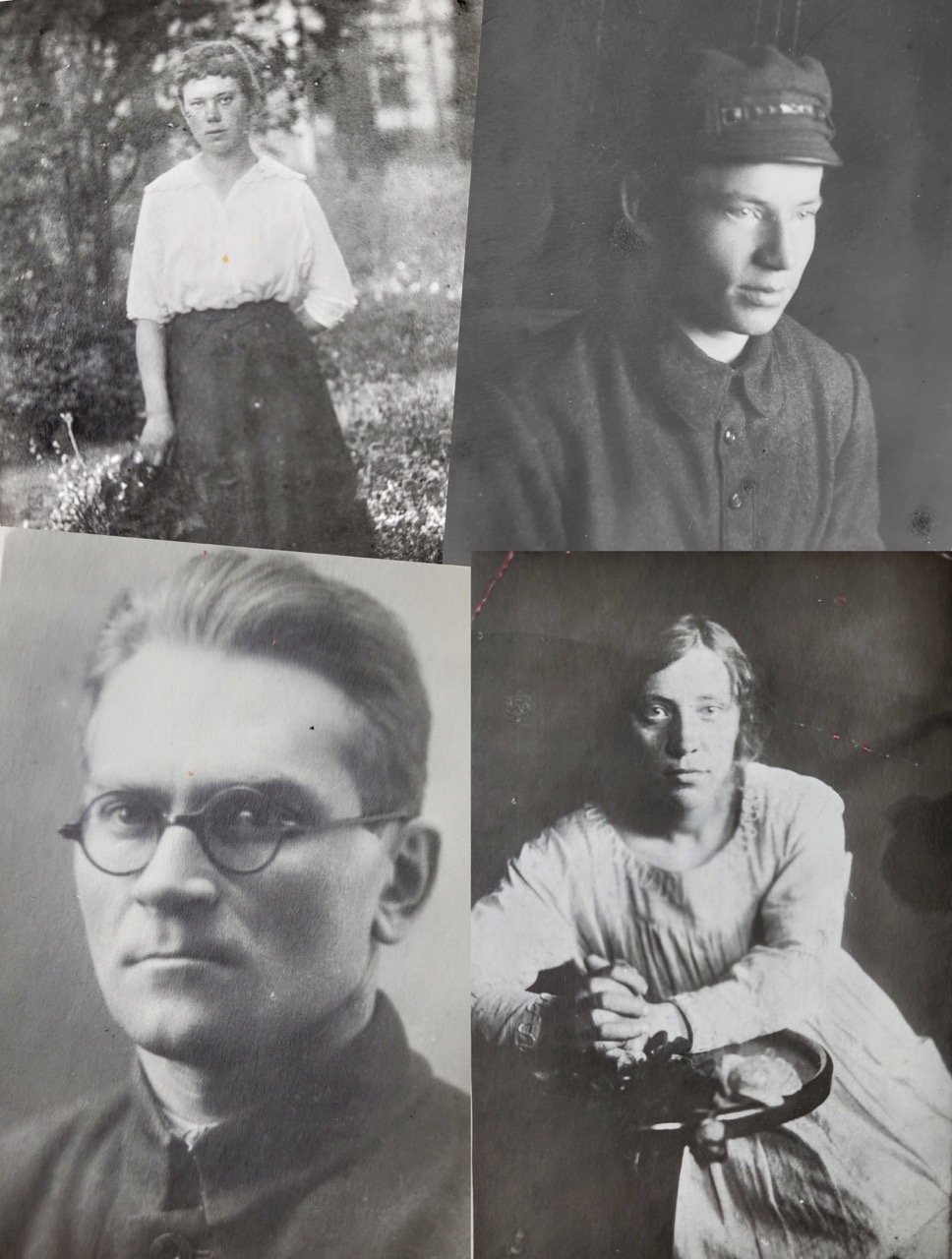
Pictured are “Kvēle” members — Vallija Krišfelde, Jānis Jākobsons, Kārlis Blūms, Marija Lars.
This description was put together using materials from:
the collections of Cēsis Museum.